
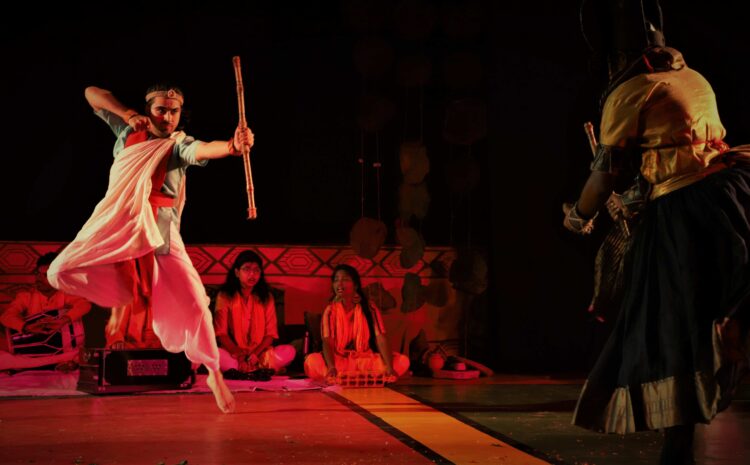
Among the unparalleled lineage of plays in Indian history, Anand Raghunandan holds a distinguished place. Originally written by Maharaja Shri Vishwanath Singh of the Rewa State (1846-1911 C.E.), this work is considered to predate even Bharatendu Harishchandra in the history of Hindi drama. Due to the use of Sanskrit and Braj Bhasha prose in the original text, scholars and literary figures have regarded this play as the first Hindi drama. Based on the story of Lord Shri Ram, the play presents episodes from the Ramayana and depicts the complete Ram narrative. In the play, the names of the characters have been altered for specific reasons, which enhances its dramatic interest. Bagheli dialect is prevalent in the Baghelkhand region of Madhya Pradesh. The original composition of Anand Raghunandan also took place in Rewa, the capital of erstwhile princely state of Baghelkhand region. The Bagheli adaptation of this play has been done by renowned writer Yogesh Tripathi. Through this production, efforts are being made to preserve and present this nearly lost dramatic work to the public. From singing styles and Bagheli dialogues to the integration of classical and folk theatre forms, the play delights its audience. Folk songs such as Sohar, Badhai, Basdeva, and other traditional songs have been used in the production. Special effects have been employed to connect the scenes with modern sensibilities. The play’s two directors, Shubham Bari and Amit Kumar Shukla, through their respective expertise, have carefully balanced special training, folk dignity, modern experiments in design, and the stability of traditional and ritualistic practices of folk culture.
Writer
Maharaja Vishwanath Singh of the erstwhile princely state of Rewa, is known for abolishing Sati in the state in 1847. The princely state was always dedicated to literature and the creation of first Hindi drama Anand Raghunandan by the king of this state justified that. Being a devotee of Lord Ram, attributing his rule to him, he issued coinage depicting “Sree Ram Adhikari,” showcasing his religious devotion.
Tranlator
Yogesh Tripathi is one of India’s leading Hindi playwrights. He edited and adapted into Bagheli the first Hindi play Anand Raghunandan written by Maharaja Vishwanath Singh, and edited and adapted Banbhatt’s Kadambari into Hindi drama. He has written more than 60 radio plays and 44 stage plays, two of which Shatrugandh and Lakdi Ka Pul were awarded at the national level by All India Radio, New Delhi. He pioneered creative experiments in Bagheli dramatic techniques in plays like Hoi Hain Wahi Jo Ram Rachi Rakha, Gabarghichor and Chhahur. His major plays include Yuddh, 1857 – Ek Avijit Vijay, Kagaz Par Likhi Maut, Oxygen, Adi Shankaracharya, and Hastakshar among others. Honoured three times with the Mohan Rakesh Award bestowed by the Sahitya Kala Parishad, Government of Delhi for his plays Mujhe Amrita Chahiye in 2002, Keshavleela Ramrangila in 2011, and Chauthi Cigarette in 2018, he continues to work on the collection, documentation, and creative adaptation of traditional theatrical forms of Baghelkhand in search of new theatrical languages and techniques.
Director (s)
Amit Kumar Shukla, active in theatre since 2015, has worked under the guidance of various theatre directors and music composers, and has staged numerous plays at national, regional, and local levels. Along with adaptation, editing, and direction, he has received special training in acting, Thang-ta, and Tai Chi. By integrating Bagheli songs and music into theatre, he has successfully directed other Bagheli oriented plays such as Manjan Ka Balidan, and 1857 – Ek Avijit Vijay, and has also staged other folk plays. He has acted in plays such as Adhe Adhure, Virasat, and Bhagavadajjukam. Currently, he serves as the Director of Aakar Welfare Society and is pursuing postgraduate studies in theatre at Atal Bihari Vajpayee Hindi Vishwavidyalaya, Bhopal.
Shubham Bari began his theatre journey in 2015, has received his initial training under the direction of Shri Dwarika Dahiya. With an early interest in direction, he completed a one-year course at Madhya Pradesh Natya School, Bhopal (2017-18), and during a one-year internship directed plays in various styles. He received training under eminent theatre practitioners of the country. He later had the opportunity to train in advance theatre at the University of Hyderabad. He has directed 21 plays, acted in 18 plays, and worked as music director in more than 10 plays.
Director’s Note
There has always been a continuous need for experimentation in the folk arts of Baghelkhand, a realization shared by theatre practitioners and writers working in the region. In this context, the revival of such a remarkable folk narrative translation by writer Yogesh Tripathi is indeed a meaningful effort. The reverence and gratitude towards the Ram narrative in folk life are evident in the creation of Anand Raghunandan. As individuals from the Baghelkhand region, raised listening to Sohar songs from birth, can easily be drawn to any of its traditions. Due to an early interest in folk music, and initial training in classical music led to travel across various regions, association with theatre groups, and in-depth study of the core elements of art and music, as well as understanding how these traditional arts could be adapted for stage performance. After training under various theatre mentors and folk exponents, sustained efforts have been made to study and stage the arts of one’s own soil—of which this production is one such endeavour. This presentation has been created to preserve culture through the image and narrative of Ram from a tribal and folk perspective. During the production process, actors were trained by various instructors. The production includes a maximum number of folk artists who are directly or indirectly associated with Ramleela or Manas singing, connecting them with theatrical and stage elements to present a meaningful performance to the public.