
Play
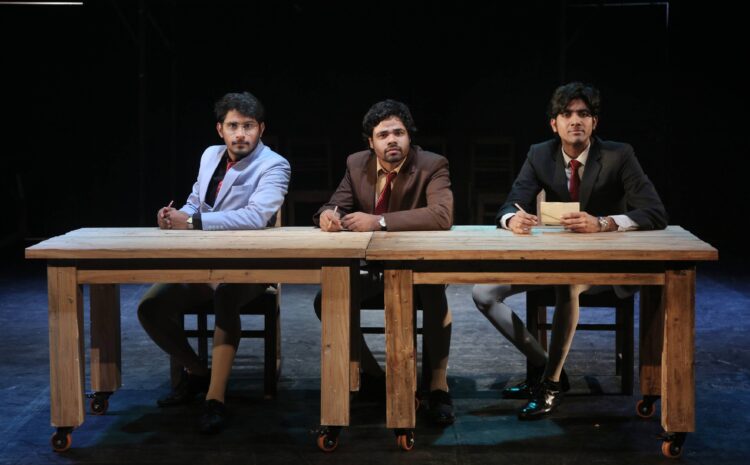
Attempts to describe her? Attempts to destroy her? Or attempts to destroy herself? Is Anne the object of violence? Or its terrifying practitioner? Martin Crimp’s “17 scenarios for the theatre”, absurd, shocking and hilarious by turn, are a rollercoaster of early 21st century obsessions. From ethnic violence to tabloid news, from terrorism to advertisements …. its strange array of nameless characters attempt to invent the perfect story to encapsulate our time. There is no plot, the script only designates a change of speaker, there are virtually no stage directions. It’s all a matter interpretation. What holds thestories together is their subject: the mysterious Anne/Annie/Anaya/Anu/Anushka. Over the course of the play Anne never appears; instead various figures discuss her life. We can’t be sure if she is a terrorist, a missing person, the girl next door, or even dead or alive. Attempts on her Life is not about discovering the truth of Anne’s identity, but the process by which we seek to discover the truth.
Director
Neel Chaudhuri is a playwright and theatre director based in New Delhi. He is a member and former Artistic Director of The Tadpole Repertory. His plays include Taramandal, Still and Still Moving, Quicksand and, most recently, Aakhirkaar. Neel is visiting faculty at Ashoka University, The National School of Drama, Bargad Theatre and Drama School Mumbai. For his work in the theatre, Neel has received the 2014 Vinod Doshi Fellowship from the Sahitya Rangabhoomi Pratishthan, the 2020 Aditya Vikram Birla Kala Kiran Puraskar by the Sangit Kala Kendra and the Shankar Nag Award (2020).
Director’s Note
Attempts on her Life is a terrifying and thrilling text. It plays with boundless possibility but also, at the same time, it confounds you with its plurality. It seems to break almost every rule of playwriting, and not always gracefully, but yet is so complete in its vision. It is anti-“theatre” in its conventional sense but also, as many directors have noted, so utterly theatrical that it is, to me, such an ideal play for an ensemble. I have wanted to direct it ever since I first read it and this opportunity – to devise with this exciting and intrepid group of third year students – seemed like an appropriate moment to experiment with the question “what is it?” rather than to rest comfortably with the notion of “what it is”. Martin Crimp wrote it at the end of the last century and so it seems to stare down at our present time with a sense of foreboding, an almost prophetic vision of what the world would look and sound like in an age of information, technology and public spectacle.
Group
3rd year Students